

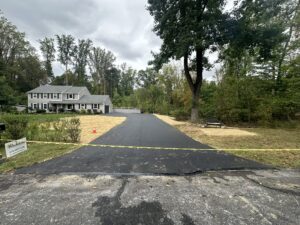
 When we first arrived at this classic two‑story colonial in Exton, PA, the driveway told a story: years of wear, crack patches, and uneven surfaces. The homeowners wanted a smooth, cohesive entrance that would restore curb appeal and function flawlessly long-term.
What we didn’t see was the hidden complexity behind those cracked lines — a curved layout, mature root systems nearby, and a property edged by woodland that challenges drainage.
This is the story of how Blackstone Paving & Excavating, LLC transformed an aging driveway into a welcoming, durable entryway — while protecting the home’s character and surrounding greenery.
Seeing the Big Picture—and the Curve
From the start, this job required more than laying asphalt. The driveway is long, gently curving as it leads to a side‑loading garage, and opens into a turning area in front of the garage.
To avoid a “bowed” or awkward look, we needed precise grading and edge control the entire length. Any tilt or misalignment would be obvious from multiple viewing angles.
Add to that, mature trees flank one side of the drive.
Their roots run just beneath the surface. Cutting too deeply or installing edges too rigidly would put those roots — and surrounding landscaping — at risk.
Finally, the home sits near wooded areas, meaning surface water and leaf litter frequently influence that stretch of land. Proper drainage, runoff direction, and post‑installation cleanup would all be critical.
We walked the full driveway carefully, marking root zones, noting existing slopes, and assessing how the driveway meets the street.
Balancing Precision with Protection
1. Subgrade & Grading
We began by removing the old surface and preparing the subgrade.
To maintain the curve’s integrity, we used string lines and laser levels across the length and around curves. Our goal was a consistent slope away from the house, tapering gently toward the street — invisible in normal view, but crucial for water flow.
2. Root-Friendly Edge Treatment
Along the trees, we exercised caution. We avoided deep trench cuts where possible and used hand‑grading near root zones. On edges, we opted for a reinforced tapering detail that preserves root zones while giving crisp asphalt edges.
This kept the trees healthy and maintained the clean line we needed.
3. Drainage and Debris Control
Recognizing the woodland influence nearby, we carefully sloped the drive so rainwater would shed cleanly to side swales. We also installed temporary erosion control (silt fencing, straw bales) along the disturbed edges to trap sediment and leaf debris during installation and curing.
4. Layering Asphalt with Care
We applied hot mix asphalt in two lifts — a base and a top — ensuring compaction and consistency. The top layer received the final grading touches to blend invisibly with the curve and turning area. At no point did we allow “pooling” or uneven patches.
5. Surface Restoration
With fresh straw and grass seed already in place along both sides, our crew protected those margins at every stage. We laid protective boards where equipment crossed, limited overrun, and cleaned stray debris continuously to prevent damage or soil mixing.
Thinking of Paving in Chester County?
If your driveway is long, curved, adjacent to trees, or near woodland areas (like many in Exton or the greater Chester County region), you’re not just hiring a paving crew. You need a partner who sees the driveway, the yard, the roots, and the drainage as one system.
Ready to see how your project can look after an asphalt paving transformation? Let’s meet in Exton — or at your address anywhere in Chester County — and plan your new approach.
Contact us today for a free driveway evaluation and design sketch made just for you.

